Financial health is about more than access.
According to the World Bank, 1.3 billion adults remain outside the formal financial system. While the number of underbanked people decreases every year, access to financial services is just the start of progress.
-
Access
Financial services available to be used.
-
Beneficial Access
Using an available service is advantageous for the individual.
-
Equitable Access
Individuals are more than customers. They are co-owners contributing to their community's collective wealth.
-
Empowering Access
Daily financial systems help an individual build economic resilience and create opportunities to pursue their dreams.
Theory of change
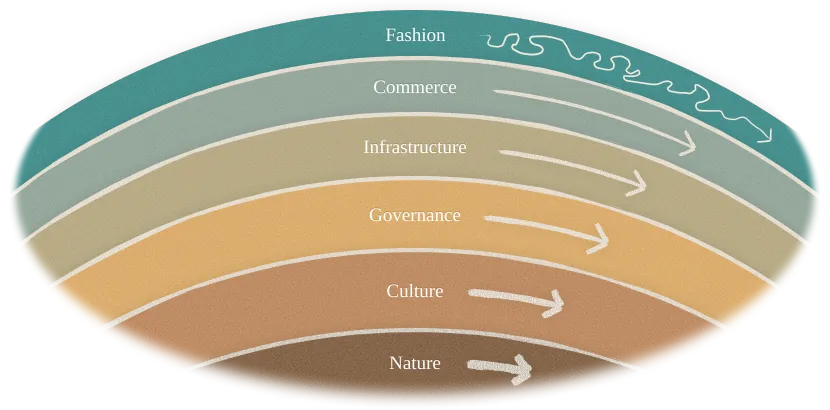
Stewart Brand and Brian Eno used a sequence of layers to illustrate how complex systems moderate change over time and remain resilient to shocks in the book The Clock of the Long Now. Each layer operates at a different scale and rate of change. The layers are ordered from fastest on the outside to slowest in the center. Conditions for life on earth change over billions of years. Trends in clothing change seasonally. “The fast layers innovate; the slow layers stabilize. The whole combines learning with continuity.”
- Innovation [fashion] keeps culture progressing.
- Value exchange [commerce] incentivizes innovation.
- Infrastructure improves access to innovation.
- Governance manages infrastructure and enforces fairness.
- Culture elects governance.
- Nature defines reality.
We apply this concept to making progress on global financial health.